Last Tuesday I had the pleasure to participate in the first "A Nobel Day" event, which took place in Lisbon and intends to spread around the world in a similar way to the TEDTalks. The idea of these events is to bring together Nobel Laureates, potential candidates and past nominees, within Physics, Chemistry, Physiology or Medicine, Literature and Peace into discussion panels around several interesting issues. More information can be found on their webside, http://www.anobelday.com/.
The first two panels, which were open to the public after registration, had the broad enough topics of "Financial Problems with Science" and "Future of Scientific Investigation" to interest non-health professionals such as myself.
I must say the event did not start all that great for me, with what I consider some strange and important organisation failures.
First, for some reason they thought I had signed up for the professionals sessions in the afternoon, and wanted to give me access accordingly. This was really strange, since to attend those you both had to pay a fee (which for me was marked as payed, although I obviously did not) and give credencials of your technical expertise in the area (which I obviously do not have).
Then the 1st panel's chair, Dr Maria de Belém, did not leave such a good impression. She seemed to struggle a lot with the (English) language, she wasted most of the time with off-topic issues (namely details on the current research project of the guests and talked in Portuguese a lot, while the guests stood idle and bored without understanding a word. Although one of the invited speaker did not say a word after the short introduction in the beggining, the chair made no attempt of drawing her into the discussion. Still, the panel managed to talk about some relevant and important issues, such as the excessive administrative/burocratic on head-researchers, different ways of financing research and where most of money has came from (historically) and why.
The 2nd panel was trully amazing and saved the day. The char, Dr Ritu Dhand (Nature Chief Biological Sciences Editor), had the confidence and expertise to keep a steady, relevant, interesting, informal and even sometimes funny conversation. Rather than the topics themselves, I would rather write about this odd situation that took place right in the beginning. After a particularly long question by Dr. Ritu, Professor Smithies (Nobel Price in 2007) replied "Can you rephrase that? I couldn't hear anything because I'm deaf". I recall immediately thinking Oh dear, they invited an old senile into the discussion just for his long passed achievements... This totally unfair thought illustrates two things: my grumpyness and stupidity when having woken up too early and, at the same time, the general western perspective towards older people. Fortunately I was soon able to realise my grave mistake and acknowledge Professor Smithis insight and quick thinking. It is amazing and scary the speed at which we can emmit (wrong) judgements about someone, especially when influenced by distorted stereotypes.
A very important point, stressed by several of the speakers, is the need to discuss the cost/benefits of some extremely expensive medical treatments. They seemed to believe that this lack of discussion is due to the unwillingness of politicians to bring it into public debate, since "no one earns votes speaking about death". Truthful as it may sound, doctors still have their share of responsability for not being able to reach general public more directly.
All in all A Nobel Day was an extremely interesting event which hopefully will be repeated around the world.
Filipe Baptista de Morais
domingo, 30 de junho de 2013

domingo, 16 de junho de 2013
Marginal à Noite
Nome da Prova: Marginal à Noite
Comprimento: 8Km
Data: 16 de Junho de 2013
Objectivos Mínimos: - 34m
Desafio Pessoal: - 32m
Melhor Tempo em Provas Semelhantes: -
Comprimento: 8Km
Data: 16 de Junho de 2013
Objectivos Mínimos: - 34m
Desafio Pessoal: - 32m
Melhor Tempo em Provas Semelhantes: -
Uma emblemática prova do atletismo (amador) nacional, a Marginal à Noite fez jus ao seu nome. Uma prova lindíssima com um percurso fantástico, esta corrida é ideal quer para os estreantes na modalidade quer para os veteranos que lá voltam todos os anos. A distância idiossincrática (8Km), ajuda a manter um certo espírito mais amigável que competitivo, espelhado na minha ausência de melhor tempo apesar de já ter participado nesta prova anteriormente (não me cronometrei).
Este ano também não estava a pensar esforçar-me por aí além, tendo-me prestado a "escoltar" uma amiga que se ia estrear neste mundo das corridas. Infelizmente acabou por não poder participar, e dadas as condições favoráveis (metereológicas e de altitude) decide que esta prova poderia ser um bom treino para o meu objectivo de melhorar o tempo aos 10Km.
Mais dois apontamentos negativos: a não existência de medalha de participação (esta prova merecia uma recordação sob a forma de troféu) e a estranha opção de colocar os patrocinadores na frente da T-Shirt, com os desenhos nas costas.
Mas não me entendam mal, a Marginal à Noite continua a ser uma das minhas provas favoritas, com um percurso e uma logística invejáveis e pelos quais a organização se deve orgulhar.
Para terminar ainda melhor, tomei conhecimento de uma prova de 10Km no próximo fim-de-semana que era até então desconhecida, a "Corrida Solidária Para Todos". Já me inscrevi, e espero que a nova motivação chegue para fazer "milagres".
Filipe Baptista de Morais
segunda-feira, 10 de junho de 2013
Like Toy Soldiers
The other day I came across this video. It's about this young american, Cody Wilson (24), who's trying to design, in the computer, gun models printable in any 3D printer around the world. The implications of this, when project succeeds, will be enormous. Experts estimate that in a few decades having a 3D printer at home will be as common as owning a desktop is today. Imagine what it would be like to just google "Assault rifle printer model" and, a few minutes later, having one coming out right in front of you.
The idealist calls himself a crypto-anarchist, and was considered one of the world's fifteen most dangerous man by the prestigious Wire magazine. Watching the video one gets the impression of a bright young student who, although completely aware of the consequences of his actions, seems strangely indifferent to them. For some reason it reminded me of the kid from Chronicle. It's startling how someone can realise that his work will be putting dangerous guns on the hands of twelve years old kids, and say it with a smile like it is something extremely interesting.
One has to wonder whether this has to do with the way killing is getting easier and easier. I'd say most people, even when angered beyond reason, wouldn't be able to stab another to death. But pulling a trigger? Or pressing a button on a computer screen? Hardly as challenging. Not to mention the loads of movies, books, series and computer games where the lead character is in happy trigger mode 24/7.
Whether it happens in 5, 10 or 50 years time it is clear there will come a time where guns will be accessible to anyone. And at this point Cody is definitely right: society does need to accept that and come up with solutions for it. It will be hard to walk the streets carelessly when you're aware anyone can draw a gun and shoot you dead in a second. Even worse, I'd worry about young children shooting their friends for stealing a chocolate bar, or loosing a footbal match. This is not Cody Wilson's fault; if not him, others would surely carry out the same work. But the question remain: how can a 24 years old american man be so insensible to such a future?
Filipe Baptista de Morais
The idealist calls himself a crypto-anarchist, and was considered one of the world's fifteen most dangerous man by the prestigious Wire magazine. Watching the video one gets the impression of a bright young student who, although completely aware of the consequences of his actions, seems strangely indifferent to them. For some reason it reminded me of the kid from Chronicle. It's startling how someone can realise that his work will be putting dangerous guns on the hands of twelve years old kids, and say it with a smile like it is something extremely interesting.
One has to wonder whether this has to do with the way killing is getting easier and easier. I'd say most people, even when angered beyond reason, wouldn't be able to stab another to death. But pulling a trigger? Or pressing a button on a computer screen? Hardly as challenging. Not to mention the loads of movies, books, series and computer games where the lead character is in happy trigger mode 24/7.
Whether it happens in 5, 10 or 50 years time it is clear there will come a time where guns will be accessible to anyone. And at this point Cody is definitely right: society does need to accept that and come up with solutions for it. It will be hard to walk the streets carelessly when you're aware anyone can draw a gun and shoot you dead in a second. Even worse, I'd worry about young children shooting their friends for stealing a chocolate bar, or loosing a footbal match. This is not Cody Wilson's fault; if not him, others would surely carry out the same work. But the question remain: how can a 24 years old american man be so insensible to such a future?
Filipe Baptista de Morais
domingo, 9 de junho de 2013
Interactable
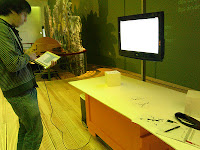
O Interactable está desde 30 de Abril de 2013 à disposição dos visitantes da Ciência Viva integrado na exposição "T-Rex quando as galinhas têm dentes" a qual estão desde já convidados a visitar até ao final de Agosto. Para os mais a leste que (ainda) não sabem o que é o Interactable é favor consultar o site. Estendo a recomendação a todos aqueles que quiserem saber mais sobre o projecto, já que lá é possível encontrar uma descrição (algo sucinta) do conceito e possíveis aplicações do projecto, assim como um breve relato dos primeiros acontecimentos no período de vida do projecto.
É provável que esta seja a última aparição do Interactable em locais públicos, já que a equipa dispersou rumo a outras experiências profissionais. No início deste percurso avisaram-nos que provavelmente não seríamos mais do que um fogacho rápido. Após uma parceria com o Hospital de Santa Maria para explorar a aplicação do projecto no contexto da intervenção em crianças com problemas em desenvolvimento, duas participações em conferências/seminários ( Tecnologias e Perturbações do Espectro do Autismo, em Guimarães, e Yes Meeting 2012 no Porto ) e um módulo em exposição na Ciência Viva (Pavilhão do Conhecimento, Lisboa) penso que toda a equipa está orgulhosa do seu fogacho. É claro que as expectativas e avaliações são sempre subjectivas, e percebo que para alguns este trajecto tenha parecido curto e sem saída. Mas a juventude é feita de experimentação e esta foi sem dúvida uma experiência rica e interessante para todos nós. Uma pequena incursão no mundo real, em que interessam mais os resultados do que os procedimentos, onde ninguém quer saber como é que as coisas funcionam mas sim aquilo que são capazes de fazer. Foi também extremamente interessante afastarmo-nos um pouco do nosso cantinho de engenharia e tentar ver o projecto por outra perspectiva, como seja a um de médico. A oportunidade/desafio de apresentarmos o projecto em meios tão diferentes daqueles que nos são familiares foi também importante para a nossa formação pessoal.
Nem tudo foram rosas neste caminho, pelo qual ficaram muitas noites mal dormidas, muita frustração quando as coisas não funcionavam, recriminação pelos nossos erros e irritação pelos de outrém e muitos (mas muitos mesmos) fins-de-semana e feríados que passaram despercebidos. Mas a satisfação de concretizar as nossas ideias e ver o interesse do "mundo" no nosso projecto é mais do que suficiente para nos fazer ultrapassar tudo isto.

 Sendo um projecto dinâmico, não é de espantar que o local de trabalho tenha variado constantemente, passando por: espaço 24h do IST (Instituto Superior Técnico), laboratório do 8º andar do ISR, Ameixoeira, Cascais, Sintra, Telheiras, um gabinete no Hospital Santa Maria, Matosinhos, Universidade do Minho, Universidade de Medicina do Porto, Alvalade, Pavilhão do Conhecimento e, provavelmente, alguns outros. Todos estes locais viram e contribuiram de alguma forma para a evolução do projecto, e geraram recordações memoráveis.
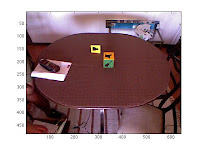 Os problemas foram muitos, desde tecnicidades a que vos vou poupar, dúvidas existenciais parvas (será que esta linha é mesmo recta? isto são mesmo 12cm?), falta de material (como raio vamos pendurar a câmara por cima da mesa? como testar alguma coisa sem suporte para a câmara? e sem mesa? e sem cubos? ), falta de pessoal (quando cada um de nós apenas podia trabalhar 2 dias por semana, que obviamente não coincidiam), pessoal a mais (por exemplo um gato em cima da mesa), sono, fome e sede, birras da câmara (a ver coisas a menos e/ou a mais: ver a foto abaixo para um exemplo) entre outros que possam (ou não) imaginar. Mas ultrapassámo-los a todos (ou varremos para debaixo do tapete, you decide) e como é bem sabido aquilo que não nos mata torna-nos mais fortes.

Nada disto seria possível sem uma equipa unida. Traz-me um sorriso aos lábios recordar que a maior parte das decisões importantes foram tomadas durante almoçaradas no Rialva, ou entre copos no arco do cego. Mas a união e a amizade não chega, também são essenciais a competência e a dedicação. Aqui posso de facto considerar-me afortunado com ter amigos cujo trabalho respeito e admiro, levando-me a elevar também o meu. André Gonçalves, José (aka Zé) Leitão e Rui Coelho foi um prazer trabalhar convosco ao longo deste ano e picos. Obrigado por me ouvirem quando tenho razão, por me mandarem calar quando digo disparates e por tantas vezes terem razão vocês próprios. Quem sabe um dia voltaremos a trabalhar juntos. As almoçaradas sei que se manterão.
Há ainda muitas outras pessoas que merecem o meu agradecimento. Do ISR (Instituto de Sistemas e Robótica), há que agradecer ao Professor João Paulo Costeira por nos ter incentivado a fazer algo com o nosso projecto, ao Hélder Miranda por nos ter calibrado a câmara numa fase inicial do projecto e ao José Jerónimo por nos deixar usar o seu algoritmo (ANSIG). Do Hospital de Santa Maria, à doutora Cláudia Lima por acreditar no potencial do nosso projecto e à terapeuta musical Catarina da Isabel por toda a abertura, disponibilidade e até pelo jeito que teve em incorporar o Interactable nas suas sessões.
Mais a nível pessoal, temos de agradecer também ao Sérgio Paiágua, por nos ajudar no desenvolvimento do site e de vários mockups que usámos para explicar as potencialidades do projecto (assim como pelas suas ideias neste campo), à Katherine Both por ser a nossa fabricante de cubos oficial durante largos meses, à Marina Marques por tomar a seu cargos as mesmas funções nos últimos meses, à Joana Marinhas por ceder a sua simpática e amigável voz a uma das nossas aplicações didáticas. Agradecemos novamente ao Sérgio por ter incorporado a equipa na excursão ao Porto no âmbito ao Yes Meeting, assim como ao Benedict Both pela mesma razão relativamente ao 1º Seminário Tecnologia e Perturbações do Espectro do Autismo, em Guimarães. Obrigado ainda à Katherine, à Joana e ainda à Tatiana Padinha por ajudarem a tornar o nosso poster o melhor frequentado em ambos os seminários/conferências.
Finalmente, obrigado à família do Zé e do Rui por nos receberem e alimentarem repetidamente nas suas casas.


Se chegaste até aqui agradeço-te também a ti, devoto leitor.
Filipe Baptista de Morais, membro fundador (e finalista) do projecto Interactable
É provável que esta seja a última aparição do Interactable em locais públicos, já que a equipa dispersou rumo a outras experiências profissionais. No início deste percurso avisaram-nos que provavelmente não seríamos mais do que um fogacho rápido. Após uma parceria com o Hospital de Santa Maria para explorar a aplicação do projecto no contexto da intervenção em crianças com problemas em desenvolvimento, duas participações em conferências/seminários ( Tecnologias e Perturbações do Espectro do Autismo, em Guimarães, e Yes Meeting 2012 no Porto ) e um módulo em exposição na Ciência Viva (Pavilhão do Conhecimento, Lisboa) penso que toda a equipa está orgulhosa do seu fogacho. É claro que as expectativas e avaliações são sempre subjectivas, e percebo que para alguns este trajecto tenha parecido curto e sem saída. Mas a juventude é feita de experimentação e esta foi sem dúvida uma experiência rica e interessante para todos nós. Uma pequena incursão no mundo real, em que interessam mais os resultados do que os procedimentos, onde ninguém quer saber como é que as coisas funcionam mas sim aquilo que são capazes de fazer. Foi também extremamente interessante afastarmo-nos um pouco do nosso cantinho de engenharia e tentar ver o projecto por outra perspectiva, como seja a um de médico. A oportunidade/desafio de apresentarmos o projecto em meios tão diferentes daqueles que nos são familiares foi também importante para a nossa formação pessoal.
Nem tudo foram rosas neste caminho, pelo qual ficaram muitas noites mal dormidas, muita frustração quando as coisas não funcionavam, recriminação pelos nossos erros e irritação pelos de outrém e muitos (mas muitos mesmos) fins-de-semana e feríados que passaram despercebidos. Mas a satisfação de concretizar as nossas ideias e ver o interesse do "mundo" no nosso projecto é mais do que suficiente para nos fazer ultrapassar tudo isto.

 Sendo um projecto dinâmico, não é de espantar que o local de trabalho tenha variado constantemente, passando por: espaço 24h do IST (Instituto Superior Técnico), laboratório do 8º andar do ISR, Ameixoeira, Cascais, Sintra, Telheiras, um gabinete no Hospital Santa Maria, Matosinhos, Universidade do Minho, Universidade de Medicina do Porto, Alvalade, Pavilhão do Conhecimento e, provavelmente, alguns outros. Todos estes locais viram e contribuiram de alguma forma para a evolução do projecto, e geraram recordações memoráveis.
 Os problemas foram muitos, desde tecnicidades a que vos vou poupar, dúvidas existenciais parvas (será que esta linha é mesmo recta? isto são mesmo 12cm?), falta de material (como raio vamos pendurar a câmara por cima da mesa? como testar alguma coisa sem suporte para a câmara? e sem mesa? e sem cubos? ), falta de pessoal (quando cada um de nós apenas podia trabalhar 2 dias por semana, que obviamente não coincidiam), pessoal a mais (por exemplo um gato em cima da mesa), sono, fome e sede, birras da câmara (a ver coisas a menos e/ou a mais: ver a foto abaixo para um exemplo) entre outros que possam (ou não) imaginar. Mas ultrapassámo-los a todos (ou varremos para debaixo do tapete, you decide) e como é bem sabido aquilo que não nos mata torna-nos mais fortes.
Nada disto seria possível sem uma equipa unida. Traz-me um sorriso aos lábios recordar que a maior parte das decisões importantes foram tomadas durante almoçaradas no Rialva, ou entre copos no arco do cego. Mas a união e a amizade não chega, também são essenciais a competência e a dedicação. Aqui posso de facto considerar-me afortunado com ter amigos cujo trabalho respeito e admiro, levando-me a elevar também o meu. André Gonçalves, José (aka Zé) Leitão e Rui Coelho foi um prazer trabalhar convosco ao longo deste ano e picos. Obrigado por me ouvirem quando tenho razão, por me mandarem calar quando digo disparates e por tantas vezes terem razão vocês próprios. Quem sabe um dia voltaremos a trabalhar juntos. As almoçaradas sei que se manterão.
Há ainda muitas outras pessoas que merecem o meu agradecimento. Do ISR (Instituto de Sistemas e Robótica), há que agradecer ao Professor João Paulo Costeira por nos ter incentivado a fazer algo com o nosso projecto, ao Hélder Miranda por nos ter calibrado a câmara numa fase inicial do projecto e ao José Jerónimo por nos deixar usar o seu algoritmo (ANSIG). Do Hospital de Santa Maria, à doutora Cláudia Lima por acreditar no potencial do nosso projecto e à terapeuta musical Catarina da Isabel por toda a abertura, disponibilidade e até pelo jeito que teve em incorporar o Interactable nas suas sessões.
Mais a nível pessoal, temos de agradecer também ao Sérgio Paiágua, por nos ajudar no desenvolvimento do site e de vários mockups que usámos para explicar as potencialidades do projecto (assim como pelas suas ideias neste campo), à Katherine Both por ser a nossa fabricante de cubos oficial durante largos meses, à Marina Marques por tomar a seu cargos as mesmas funções nos últimos meses, à Joana Marinhas por ceder a sua simpática e amigável voz a uma das nossas aplicações didáticas. Agradecemos novamente ao Sérgio por ter incorporado a equipa na excursão ao Porto no âmbito ao Yes Meeting, assim como ao Benedict Both pela mesma razão relativamente ao 1º Seminário Tecnologia e Perturbações do Espectro do Autismo, em Guimarães. Obrigado ainda à Katherine, à Joana e ainda à Tatiana Padinha por ajudarem a tornar o nosso poster o melhor frequentado em ambos os seminários/conferências.
Finalmente, obrigado à família do Zé e do Rui por nos receberem e alimentarem repetidamente nas suas casas.


Se chegaste até aqui agradeço-te também a ti, devoto leitor.
Filipe Baptista de Morais, membro fundador (e finalista) do projecto Interactable
quarta-feira, 5 de junho de 2013
Equally Sad
This morning I was reading this news about an unusually high number of people being killed by lightning in India in the last twenty-four hours and was puzzled by the way they emphasised some of them were women. I understand the death of children may seem particularly tragic, by why would women dying be any more disturbing than men is something I really don't get.
I suppose if we were talking about civilian casualties in a war scenario it could make sense, even though a male civilian is every bit as defenseless as a female one when facing armed and trained soldiers. In a natural disaster context however, the distinction seems accidental and meaningless.
I suppose if we were talking about civilian casualties in a war scenario it could make sense, even though a male civilian is every bit as defenseless as a female one when facing armed and trained soldiers. In a natural disaster context however, the distinction seems accidental and meaningless.
domingo, 19 de maio de 2013
1ª Corrida de Belém
Name of the Competition: 1ª Corrida de Belém
Length: 10Km
Date: 19th May 2013
Minimum Objectives: - 42m
Personal Challenge: - 40m
Personal Record for this Length: 39m 42s
Date: 19th May 2013
Minimum Objectives: - 42m
Personal Challenge: - 40m
Personal Record for this Length: 39m 42s
Average Heart Beats per Minute: 184
Maximum Heart Beats per Minute: 193
Today I took another attempt at breaking my 10Km personal record, set in 2010, though I didn't really believe it to be possible since I'm still regaining my form after the last injury. Since it was the first edition of this race, I must confess I also feared that the organisation would mess up somehow. Thankfully everything went great.

On my way there I was checking my heart beats and I never saw them go below 60bpms, which was not great. Not that worrying either: I knew it would be more important for me to able to reach very high bpms: it is no coincidence that I have reached 218 during my best ever 10Km race.
The athletes going for the shorter race had a delayed departure, which made it much easier to speed up in the beginning. The support area was ok and all runners were awarded a (technical) T-Shirt and a medal. Since it had, comparing to other similar races, a cheap registration I recommend everyone to try it next year. It was a fairly easy track, with barely any slopes along the whole way.
Thanks to the well organised departure I was able to start quite well. My heart beats jumped immediately to 174, usual numbers for this type of running. The first kilometer featured the highest slope in the entire race, though, which obviously slowed me down. I finished the first kilometer in 4:19:08 (13.85Km/h average), which meant I was 20 seconds short. I blamed it on the inicial acceleration and the slope, and tried to hasten up the pace a bit.
Indeed, three kilometers later my watch marked 16:02:03 so I had won back 18 precious seconds with my 15.38Km/h average over this length. Still a long way though. At this point I was quite cheerful and confident, since I was feeling the wind slowing me down which meant that, after turning, it would be a nice helping hand for the final effort.
I reached the 5th Kilometer mark with my clock marking 20:00:01, only 1 hundreth of a second behind schedule! Things were looking pretty great by now.
Around the 7th Kilometer we turned 180º for the final lap, and it signalled the end of my hopes as well. Somehow I had managed to misjudge the wind's direction, since now it really was blowing strongly against us. I tried to keep up the pace, but at the 9th Kilometer my time was 36:29:01 which, given the conditions, meant that my record would hold yet again. The minimum objectives seemed secured though.
Due to lack of motivation I confess I faltered a little bit, until Foster the People came to the rescue with "Don't Stop". I ended up crossing the finishing line in a sprint at around 40:35:00 (still waiting for official time).
All in all it was a good race, and I've gained some confidence for Corrida do Oriente, the next 10Km competition, coming in just 2 weeks. Hopefull with better wind conditions I'll finally be able to beat 39:42:00.
Filipe Baptista de Morais
sexta-feira, 17 de maio de 2013
Back to Scandinavia
Not long after my trip to Finland I went all the way up to Scandinavia again. This time the destination was Oslo in Norway, another country which I had never set foot in. It was mostly a matter of opportunity and timing: a friend was travelling there in that weekend and was still looking for a travelling partner. After checking the price of the tickets, which were amazingly cheap (the train to Faro was more expensive than the flight to Oslo), I didn't need to do much more thinking before hopping on the plane.


- Frognerparken (in the picture). Featuring hundreds of statues from one of the famous sculpture Vigeland this park is a perfect merge of natural and man-made beauty.
- Aker Brygge. The harbour area is one fo the most beautiful areas in the city. You have a nice view over to the fjords, as well as Akershus Castle. The city hall must have made its arquitect really proud, and inside you can appreciate beautiful works of art. Don't forget to look out of the windows oveer to Aker Brygge's plaza and the fjords. Close by you can find other buildings of interest, both in social and arquitectural terms: the parliament, the national theatre, the university and the royal palace. You can also see some buildings still under re-construction; a painful reminder of the events in 2011, when a lone terrorist tried to assassinate the prime minister before inflicting the massacre in Utoya.
- Akershus Castle. You can visit some of the interior rooms which are still being used in oficial meetings and important events. The castle seems to fit with its surrounding environment marvellously well for such a massive and purposeful structure. Inside the gardens and its surroundings you can find some monuments to the deceased over the two world wars.
- Bygdoy. Often referred to as Oslo's museum Peninsula due to the large number of museums you can find in there it is a must for any traveller. Even though you can get there by bus, I'd recommend taking the ferry since the trip is much more pleasant, with Aker Brygge over one side of the (small) ship and the fjords to the next. I've visited the Norwegian Folk Museum, the Polar Ship Fram Museum, the Kon Tiki Museum and the Viking Boats Museum and I really can't pick one as the best. They were also quite original: not the usual stuff you see in a place like that. There are many more probably worth a stop, but time really is precious if you're staying in Oslo for only three days.
- Opera House. The building has a very peculiar detail: the ceiling is not flat such that, from the outside, you can walk all the way to the top of the building for a nice view. On your way back, make sure to walk by the new office buildings next to the railways: they're trully impressive and a clear sign of Norway's blooming economy. I was fortunate enough to have one of my friends working at the DNB bank and so I was able to see it from the inside. Whatever you end up doing in your life, no doubt you'd love working in a place like that.
- Holmenkollen Ski Jump. Even for one who loves skiing as much as myself, the height of this jump is too scary to have any desire of ever trying it. Still, you can go all the way for an amazing view and visit the ski museum while you're at it. If you can afford it, it should be nice to use the new slide apparatus from the top to the bottom.
- Nobel Peace Center. Perhaps not one of the city's most popular attractions, the center is definately worth a visit. I spent around one hour in there and it was clearly too little. Besides historical perspectives and information on all laureates with the Nobel Peace Prize, the museum also manages to display a modern appeal by having extremely up to date exhibitions and high-tech looking human-machine interfaces.
Unfortunately that was the last I heard of cheap stuff: everything in Oslo is crazy expensive. Still, Norwegians earn more than enough to afford it so it should be a nice place to live. The city itself is full of colour, not like the usual dull streets of gray buildings you see everywhere. It also features quite its share of green and the whole city seems nature friendly somehow.
Speaking of friendly, Norwegians are quite friendly as well, and always willing to help and/or give directions. They also speak perfect English which is useful if, like myself, your Norwegian is limited to a couple of pickup lines and some other random and ackward words. Unfortunately, there's no way you'll be able to guess the pronunciation of any Norwegian name through its spelling, which hinders your chances of getting useful answers. It allows us to play a funny game though; when riding on the bus/metro try listenning to the names of the stations and match them to the corresponding spelling. I warn you: it's a losing game (until you get the first one, that is).
Having heard quite a lot about the 'Nordic functional design' I was quite curious about the hotel. I wasn't disappointed: the lobby and restaurant were cozy and inviting and it didn't look cheap at all. (Well, it was only "cheap" in Norwegian terms). The room itself was a paradigmatic case of functionality: though quite small, it somehow managed to feature 2 beds, a desk, a sofa and 2 plasma TVs. Much more "functionality" than what I am used to see in larger rooms. The staff was quite nice, and it was rather funny when they mistook us for an Italian couple since neither of us was Italian. Neither are we a couple for that matter. Breakfast at the restaurant was amazing, and so was dinner (scary prices though). City center is around 7minutes by bus. In case you ever go there I can vividly recommend the PS Hotell in Oslo.
In terms of sightseeing, Oslo is a very interesting city with lots of things to see. Way too big to see in 3 days, even for a long distance runner such as myself. With the Oslo Pass you can travel anywhere and go into (almost) all of the museums for a very good price. I'd definately recommend not missing
What more can I say... Norwegian food is great (healthy and tasty, perfect combination) as long as you can afford it. Norwegian women are stunning so keep your eyes open.
All in all it was a great trip and I still managed to visit some friends who were kind enough to host (and feed!) me for a night. Hopefully I'll come back to Oslo someday for some more in-depth sightseeing.
Filipe Baptista de Morais
Subscrever:
Mensagens (Atom)
